Sunday, January 31, 2010
Saturday, January 09, 2010
Leadership Accountability - Losing Control of Your Staff?
Author: Gary B Cohen
Reader's Question: I am a sales manager for a business services firm in Minneapolis. I am responsible for all new business revenue for my company and I have 5 sales people that work for me. Of the 5 sales people only one is a star performer. The issue I am having is he breaks all the rules and creates really bad relationships with all the other people in the company. I am on the senior team and the rest of them are angry that this keeps happening. While I don't like to hear the comments from the senior team, I am aware that I cannot make my numbers goals and the company can't make there's for the year without him. What do I do?
Answer: I call this a terrorist! A terrorist is someone who knows what they have on you and they use it to hold you and everyone else in the company hostage to their behavior. I like to take my clients through an exercise of understanding the Goal, Position, and Strategy Questions to determine what actions need to be done.
The first question I ask is, "What is the goal around the problem?" This is to ensure that we are aiming at the right issue. What I invite my clients to do is to first reflect on the organization's overall goal. Then link that to the current situation. This way what ever you do, you will be in total alignment with what is best for the business overall.
In this situation you have identified the fact that in order to make your business unit's goals and the company's, you need this employee. That is a big step and oftentimes leaders become so emotionally charged by such situations they act before they consider the goals and objectives of the company or the department. I commend you for your forethought. Typically leaders who do this are considered high in emotional intelligence. This has been shown to be one of the key components in assessing one's long term success in their career.
The next step is to understand the position you and your company are in. Elevate to 50,000 foot level to see the whole situation. Go beyond yourself and ask, "How did this begin to happen? Sometimes we might find the root cause built into the culture of the organization. Is this type of behavior is tolerated here?
In the case of Enron when the CEO learned that two of the traders were stealing from the company he did nothing and then soon after said, 'keep making us money.' What they were stealing was minor compared to what they were making the company. He knew that if he took action, he would stop his revenue machine that he needed because it was his end goal. It also gave permission to the others that if they were that good at making money for the company they could steal from the company as well. It was the outcome they got, should not have been a surprise. This is the extreme case of the terrorist working for the company - and it was exaggerated by a lack of moral compass by the leadership. In the case you present, it is apparent that this behavior is contrary to what the leadership tolerates is searching for from a behavior.
Once you go up to the 50,000 foot level and see if the company has had complicity in the situation, then it is good to come down to 10,000 foot perspective and see if "you" have complicity in the situation. To be frank, and I hate doing this in a column where I can't ask qualifying questions, but it is hard to imagine that you did not allow this to happen. It is not about absolving the terrorist from his behavior because that is wrong, however, if you had stopped the behavior cold, this would never have happened. I say this because the solution, whatever one you choose, will need to involve your being mentored or coached into creating boundaries for your team. Without these boundaries you will be faced with this issue again.
The third part of our position investigation is to go to ground level – the situation itself. When we find ourselves in this type of situation with an employee we only have two choices, we can either fire or teach. If an employee makes a mistake, it is because we did not teach them correctly or because they are not capable to do the function. Ask three questions to determine what choice to make. The first, is the employee capable of learning? Secondly, does the organization or I have the time and resources available to train this employee? Lastly, is this employee motivated to learn and change? If you answer anyone of of these questions is NO, the decision is chosen, you need to let this person go. The decision is, as Donald Trump would say, You're Fired!
It is unclear from your description if the employee has the capacity to change behavior, so I will assume that he is rather good at what he does for your organization and likely has the ability to change. It is clear that for your number one producer you should have the resources and time to help him come into alignment with the company. The bigger issue is that of motivation. Often times a terrorist does not feel the threat of what can happen to them if they don't start falling in to line. They have become fat, and happy and arrogant! This arrogance is what blocks their ability to realize that they need to change. The company has reached a point where it can no longer tolerate this kind of behavior.
Unlike Donald's TV Drama we live in the real world, and just letting him go is not a great first choice given the company's dependence on his revenue.
In almost all other circumstances the move would surely be to fire, but because this employee mean so much to the organizations health as far as revenue.
The last part of understanding our position is to understand whose decision is it to make, and what needs to be done. If the consequences of your actions will compromise the strategic direction of the company, I would invite you to consider involving the senior team and that the responsibility is yours to deal with it, and the final decision may actually be the team's or the CEO's call, given its importance to the organization.
This is truly a strategic decision then, it is not simply letting one person go, it is letting many people go, if one presumes in a service firm, lower revenue means fewer employees needed to service the customers.
At this point I would coach you to have a conversation with your CEO and the rest of the strategic team and tell them the steps that you are considering and ask these strategic questions: At what point as an organization are we willing to take a principled stance on the issue over that of revenue? Are we clear what the outcome of this will be to our other employees? Will we need to do cost cutting to compensate for this move? What will the industry see from losing our most talented sales person? Will he go work for our competition? What impact will that have on your company? By working through these strategic issues as an organization and lifting this issue to its proper place the senior team - you will be aligning everyone to be part of the process and stop complaining about it.
By going through these questions the conclusion you may arrive at the end of this process is that you use a three pronged approach to dealing with this situation. Executing three plans simultaneously.
Plan "A" You will need to continue coaching the employee towards the behavior that is in alignment with the firm's values, beliefs, and rules.
Plan "B", at the same time I would highly recommend moving the rest of the sales team to a higher level to loose your dependence on this terrorist, and operationalize Plan "C" and start the recruiting process for the possible if not probable replacement of the employee.
It is important that the others on the senior team and your sales team know that you are coaching this employee in these areas of behavior and that it is not sitting OK with you. But no more information than that - it is inappropriate to say more than that in a public setting. It will build your credibility as a leader and not allow one persons behavior sink the culture the company wants to build.


Saturday, May 03, 2008
How can I ignite imagination?
Gary Beck says that igniting imagination comes from rubbing minds together. With all of his leadership and marketing experience (as former President of FCB Database Marketing Group and former Executive Director of Database and Infrastructure for vehicle sales and services marketing at General Motors), he ought to know.
Naturally, questions are an integral part of bringing people (and minds) together. At your next strategic planning session, consider starting with personal accumulation: asking each group member to write down all the potential solutions that they can think of to a particular question. When pens come to a rest, ask group members to share one idea, then proceed in order around the room until all potential solutions have been voiced. In doing so, everyone will get heard, and group members will listen closely so that they don't repeat an idea.
Be sure to use open-ended questions that don't point responders to your opinions or cut off potentially creative avenues.
Here are some questions you might ask:
Not all ideas will be usable, of course, or worthy of extended discussion, but don't dismiss anything initially. The biggest impediment to creativity is having critics or skeptics in the room. The group will take its cues from you, the leader/moderator. Make it clear up front that all ideas are welcome—no matter how hare-brained or obvious or radical they may first appear. Those ideas may be the ones most easily missed—and perhaps most indispensable.
Gary Beck says that igniting imagination comes from rubbing minds together. With all of his leadership and marketing experience (as former President of FCB Database Marketing Group and former Executive Director of Database and Infrastructure for vehicle sales and services marketing at General Motors), he ought to know.
Naturally, questions are an integral part of bringing people (and minds) together. At your next strategic planning session, consider starting with personal accumulation: asking each group member to write down all the potential solutions that they can think of to a particular question. When pens come to a rest, ask group members to share one idea, then proceed in order around the room until all potential solutions have been voiced. In doing so, everyone will get heard, and group members will listen closely so that they don't repeat an idea.
Be sure to use open-ended questions that don't point responders to your opinions or cut off potentially creative avenues.
Here are some questions you might ask:
- What is most important to the customer?
- What are clearly differentiable aspects of the product that we are trying to sell to the customer?
- How do we best communicate this particular aspect to our target customer?
- Who is our target customer?
Not all ideas will be usable, of course, or worthy of extended discussion, but don't dismiss anything initially. The biggest impediment to creativity is having critics or skeptics in the room. The group will take its cues from you, the leader/moderator. Make it clear up front that all ideas are welcome—no matter how hare-brained or obvious or radical they may first appear. Those ideas may be the ones most easily missed—and perhaps most indispensable.
Tuesday, July 10, 2007
Increase Team Member Accountability
Dear Coach,
I own and run a company, but my leadership skills are sometimes lacking. My Senior Team refers to me as “Mr. Softy,” because I fail to discipline those who breach company policies. I am having particular difficulty with my VP of Sales. While he does bring in new accounts, he consistently enters them incorrectly and causes all sorts of problems for production staff. My team keeps telling me to “let him have it,” but I am not sure what to say. How do I make him accountable without simply firing or threatening to fire him?
Congratulations! You are already demonstrating great leadership wisdom by seeking solutions aside from threatening job loss. The accountability you want would never develop from firing or threatening to fire, anyway. Exceptional leaders build accountability and empower their employees by asking them questions. My philosophy of leadership is “ask, don’t tell.” Although you have identified the VP of Sales as causing the current problems, make sure you have all the facts. This could be a great opportunity for you to build accountability – not just in this employee, but in all your employees.
I suggest holding a company-wide meeting, focused on the big picture of how sales orders are processed. Use the situation with the VP of Sales as an example, and ask, “Is this order representative of how this company functions?” Either everyone will agree, or an interesting discussion will ensue between the disagreeing parties. Sometimes, your role as a leader is to stay out of the middle and simply facilitate. The managers of your various departments likely understand the facts better than you do, and it is perfectly ok to admit this. Enter the meeting with an open mind. Even if your employees begin by arguing and finger-pointing, they will eventually work through to the facts. You may need to pepper the conversation with questions, but try not to give answers.
Once the group has pinpointed the actual problem and the individual(s) involved, begin discussing solutions. Ask simply, “How would you like to solve this?” Even if you have solutions in mind, great leadership requires you to trust others to develop their own answers. Given this is the first time you have undergone this process, I suggest you stay in the meeting. Continue to only ask questions, and if asked your opinion, refrain from giving it. Remind your managers that you trust them to run their departments and make money for your company, so surely you trust them to solve issues, such as this one. Initially, this entire process may be extremely time-consuming and frustrating for everyone involved. Be confident that you are moving in the right direction! Your employees will soon become more energized as they feel empowered, and the time will prove well worthwhile. By the end of this process, you too will find your power and realize you built accountability by merely asking questions.
Remember: Ask, don’t tell.
Tuesday, November 01, 2005
When is my curiosity a detriment to the organization?
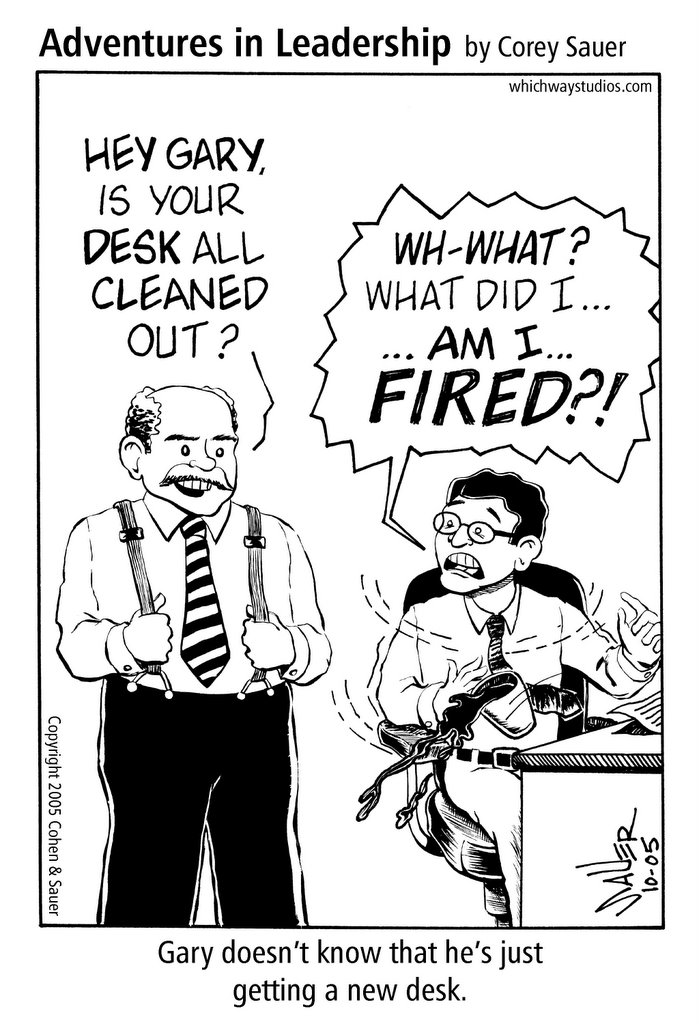
When you log onto the Internet, do you stay focused on your search exclusively, or do you occasionally follow strings of curiosity? We often go where our curiosity takes us, which is human nature and usually fun. Problems arise, however, when our curiosity takes someone else for a ride.
If you are conversing with a subordinate about their work, be sure to frame your questions. Explain why you are asking the question (you want to gather information to make a decision yourself or you want to learn about how this person is making a particular decision, for example), so that your subordinates do not make presumptions about what they should or should not be doing. If you fail to frame your questions, even if the setting is informal, your subordinates might assume that you want them to set a new course using your questions as a guide. They might, for instance, take a simple clarification question (“Why are you using the hand-carved ornaments?”) as an indication that they should have made a different decision (factory-made ornaments).
It is okay to be curious. In fact, it is probably a trait that helped transform you into a leader. But be sure to let your subordinates know when you are just being curious, so they can better assess how to proceed with their work.
John Urban of Pioneer Hi-Bread International wanders around the company at least one day each month. He might walk into someone’s cube, look at his or her nameplate, and ask, “So, Peter, any new surprises in accounting lately?” Whether there happened to be any new surprises or not, John always shared with the employee the reason for his question before leaving. He found if he did not communicate the “why,” the employee was likely to wonder about the reason for the CEO’s visit. Was there an accounting surprise that I should have found? I best go look closer at what I have done just to make sure.
The old adage “a small turn from the captain of the ship will turn major wheels down below” holds true. Know clearly what you want to accomplish with your questions and frame your questions so your subordinates know the “why.” If you are not clear, you might wind up with unintended consequences—like factory-made ornaments or a shift in accounting practices.
Thursday, September 15, 2005
Ego vs. Altruism

Why is it important to lead with questions? Why this strategy over others?
Organizations are made up of people. Like you, every employee has his/her own goals, aspirations, concerns, experiences, and dreams. And each of us has an ego. The ego allows us to believe that we are capable of performing many tasks successfully. In all likelihood, your ego is what propelled you to a leadership position. Your great effort and desire to succeed led to major accomplishments and accolades.
Here comes the paradox. Egos can vault you into a leadership position, but as a leader, you must set your ego aside. Your ego can prevent you from being an effective and truly great leader.
Before you became a leader, you likely operated as an individual contributor. You used your creativity and resourcefulness to meet objectives—a reduction of resources, an increase in quality, or an increase in revenue. If you asked questions, they were about how you could accomplish a specific task. In general, however, your ego discouraged you from asking questions and disliked having to follow orders. Egos want to accomplish and achieve. And, egos crave recognition from others.
Every time you accomplished a task and met the objective, your career moved forward and your standing in the organization or community grew. With each accomplishment, your ego grew, too. You asked fewer questions and provided more answers. After all, with your success, others came to you as an oracle of information—perhaps even your boss or your boss’s boss. You were in control.
As a leader, you must relinquish control. You must shrink your ego and concentrate on altruism. Your career advancement is no longer task-oriented. Leadership is about allowing others the chance to achieve and flourish. You advance as a leader only when you place your employees’ egos above your own. The heads of many organizations are not able to do this. Their companies may still succeed based upon their drive for individual success, but they are not true leaders. For one thing, their employees will not be inspired to reach their full potential because they know they will not receive full credit for their efforts.
General Jack Chain is a true leader. When he was in the Pentagon, serving as a staff officer, his ten-year-old daughter asked him, “What do you do?” He thought for a minute and said, “I answer questions.” Later, when he was made a commander, he reminded his daughter of their earlier conversation. She asked him how his new role would be different. His response: “Now I ask the questions.”
As a leader, why should you lead with questions? Because questions confer power and control to your employees. It allows their egos a chance to shine. And you, they, and the organization will all be better served.
Independence Day
We have more individual choices than ever. We can choose from sixteen movies at a megaplex, eight different kinds of orange juice (low acid, some pulp, not from concentrate, etc.), and countless shoe brands and styles. Is it any surprise that we want to be free to make choices in our jobs as well?
If you grew up with only four TV channels to choose from, you might believe the command-style leadership is still viable. You might believe in shared values and needs, the way we did in the ‘60’s. Unfortunately, centralized leadership doesn’t work with this new generation. They want to work their way, not your way. They know what motivates them, how they best achieve results and obtain information, and they want to receive full credit for their efforts. If you try to steamroll their independence, you will wind up with flattened cartoon characters, not productive employees.
As a leader today, you must decentralize the power and authority. With leadership opportunities, your employees will find personal meaning in the work they do. And they will do it well, provided you meet their needs. Your challenge—accommodating leaders on all levels of the organization—is daunting, maybe even terrifying. How do you align each employee’s needs with the needs of the organization? With so many leaders, so much independence, will chaos be far behind?
Not necessarily. Not if you build in some safeguards. It’s important to understand that total independence is often desired, but not always healthy. Individualism can lead to a sense of helplessness, and this helplessness can lead to depression. Despite fiercely independent childhood heroes like Superman, Batman, and Wonder Woman, we want and need to be part of something greater than ourselves. We want the support of a community.
We want to feel like the work we do has meaning not only to ourselves, but to others. Chances are, this meaning has already been established—in the form of your organization’s founding mission, vision, goals, and values. These pillars were originally set by the founder and then enhanced through time by the organization’s leadership teams. As a leader, you can bring this meaning to your employees by frequently asking how their needs and goals match the organization’s. In doing so, you give them the respect they want and need, as well as communicate a sense of belonging to a larger community.
Do you believe in your organization’s mission, vision, goals, and values? If so, you will be able to impart this sense of togetherness to your charges. If not, you will be herding cats.
Authentic leadership requires allowing everyone to lead at times, but to instill one cohesive purpose, so that these leaders will work together and move in one overarching direction. For each and every project, ask yourself, “How does this contribute to our organization’s mission, vision, goals, and values?” Ask the same of your direct reports. And have them ask the same of their direct reports.
If you grew up with only four TV channels to choose from, you might believe the command-style leadership is still viable. You might believe in shared values and needs, the way we did in the ‘60’s. Unfortunately, centralized leadership doesn’t work with this new generation. They want to work their way, not your way. They know what motivates them, how they best achieve results and obtain information, and they want to receive full credit for their efforts. If you try to steamroll their independence, you will wind up with flattened cartoon characters, not productive employees.
As a leader today, you must decentralize the power and authority. With leadership opportunities, your employees will find personal meaning in the work they do. And they will do it well, provided you meet their needs. Your challenge—accommodating leaders on all levels of the organization—is daunting, maybe even terrifying. How do you align each employee’s needs with the needs of the organization? With so many leaders, so much independence, will chaos be far behind?
Not necessarily. Not if you build in some safeguards. It’s important to understand that total independence is often desired, but not always healthy. Individualism can lead to a sense of helplessness, and this helplessness can lead to depression. Despite fiercely independent childhood heroes like Superman, Batman, and Wonder Woman, we want and need to be part of something greater than ourselves. We want the support of a community.
We want to feel like the work we do has meaning not only to ourselves, but to others. Chances are, this meaning has already been established—in the form of your organization’s founding mission, vision, goals, and values. These pillars were originally set by the founder and then enhanced through time by the organization’s leadership teams. As a leader, you can bring this meaning to your employees by frequently asking how their needs and goals match the organization’s. In doing so, you give them the respect they want and need, as well as communicate a sense of belonging to a larger community.
Do you believe in your organization’s mission, vision, goals, and values? If so, you will be able to impart this sense of togetherness to your charges. If not, you will be herding cats.
Authentic leadership requires allowing everyone to lead at times, but to instill one cohesive purpose, so that these leaders will work together and move in one overarching direction. For each and every project, ask yourself, “How does this contribute to our organization’s mission, vision, goals, and values?” Ask the same of your direct reports. And have them ask the same of their direct reports.
Sunday, September 04, 2005
The Annoyance Factor
Question: Have you written on the "annoyance factor” yet? In my eighteen years running business affairs at three different studios, we always talked badly about the "leader" who could only ask questions and never come to a decision. I agree with your premise about Ask, Don't Tell, but not taken to the extreme. Do you? Do you really? No, I mean do you really? See what I mean?
Answer: I like that, “annoyance factor.” I have been accused of it more than once from my former direct report. She became annoyed when she believed I was leading her somewhere that I wanted her to go. As an “Ask, Don’t Tell” leader, if you receive a lemon face (all forehead lines bunching and lips puckering) or a particularly loud sigh, it could be because you are making employees fish for a specific answer you have in mind. If you do know exactly what you want, don’t play games. This is when you should tell, not ask.
One key to avoiding the “annoyance factor” is to ask yourself, “Am I the decision maker here?” when employees confront you with a problem. If you are the appropriate decision-maker, you need to pitch your questions so that your direct reports will provide you the information you need. If not, you need to ask non-leading questions that will assist your direct reports with making their own decisions. If you are unsure about who will make the ultimate decision, you will often ask the wrong questions and annoy (or confuse) your employees.
If you are the decision-maker, your first questions likely will revolve around establishing the problem. It is a mistake to try to solve problems before fully understanding their complexity. Then, after brainstorming potential solutions, rank the best options, determine who will be responsible for implementing the plan, assign a timeline and communication plan, and build in a feedback loop to ensure that all aspects were done correctly.
Sometimes employees will encourage you to make a decision when, in fact, they are simply shirking their responsibility. No matter how much they slump their shoulders and give hangdog looks, you must not make their decisions for them. If you do, be prepared to make more and more decisions for them in the future. Pretty soon, you might as well assume their job title.
How can you help your employees make decisions on their own? What sort of questions should you ask? How do you provide wisdom without telling your employees how to accomplish the objective? First, be clear. Here’s what you might say: “I really would like to help you with this issue, but I won’t provide you with an answer because this is your decision to make and I trust you to make the call.” Then ask your employee questions that you would ask yourself if you were in his/her position. You might start by asking the employee to define the problem in more specific detail. Have your employee jot down his/her own answers. Explain that you will not be doing anything with this information. The decision is still the employee’s to make.
If you are not the decision-maker, remember that you are the teacher, not the learner. If you position yourself as the learner, you will subtly suggest to the employee that you intend to come to an independent decision about the problem at hand (even if you never reveal your decision to the employee). By positioning yourself as the teacher, you will impart a valuable message to your direct reports—trust. You trust them to fully establish the problem and make their own problem-solving decisions. And you have helped define boundaries—your role vs. their role. Your employees will leave your office inspired to make good decisions.
Sometimes leaders can use questions to shirk their own responsibilities. A venture capitalist shared with me a story recently about how the senior partners at [his or her?] company were providing assignments to junior associates without any explanation or resources. When the junior associates went to the seniors for help, they would engage in “annoyance factor” questioning. The junior associates would ask for direction and the senior partner would say, “How do you think it should be done?” Inwardly the junior associates were saying, “If I knew that, I wouldn’t have come to ask you!”
Sometimes leaders behave irresponsibly because they are intent on re-enacting what happened to them as junior associates. If I had to suffer, why should it be any different for my employees? Instead, a true leader would ask, “Why did this system work so poorly when I was a junior associate?” and “How can we improve the performance and morale of our junior employees?” Leaders seek to uproot dysfunctional systems, not perpetuate them.
To avoid the “annoyance factor,” determine who is the appropriate decision-maker for the problem at hand. If the decision is your employees’ to make, let them make it. Ask non-leading questions. Be sure your employees have a clear objective and access to enough information and resources to complete their work. And convey your trust in them to make good decisions.
Answer: I like that, “annoyance factor.” I have been accused of it more than once from my former direct report. She became annoyed when she believed I was leading her somewhere that I wanted her to go. As an “Ask, Don’t Tell” leader, if you receive a lemon face (all forehead lines bunching and lips puckering) or a particularly loud sigh, it could be because you are making employees fish for a specific answer you have in mind. If you do know exactly what you want, don’t play games. This is when you should tell, not ask.
One key to avoiding the “annoyance factor” is to ask yourself, “Am I the decision maker here?” when employees confront you with a problem. If you are the appropriate decision-maker, you need to pitch your questions so that your direct reports will provide you the information you need. If not, you need to ask non-leading questions that will assist your direct reports with making their own decisions. If you are unsure about who will make the ultimate decision, you will often ask the wrong questions and annoy (or confuse) your employees.
If you are the decision-maker, your first questions likely will revolve around establishing the problem. It is a mistake to try to solve problems before fully understanding their complexity. Then, after brainstorming potential solutions, rank the best options, determine who will be responsible for implementing the plan, assign a timeline and communication plan, and build in a feedback loop to ensure that all aspects were done correctly.
Sometimes employees will encourage you to make a decision when, in fact, they are simply shirking their responsibility. No matter how much they slump their shoulders and give hangdog looks, you must not make their decisions for them. If you do, be prepared to make more and more decisions for them in the future. Pretty soon, you might as well assume their job title.
How can you help your employees make decisions on their own? What sort of questions should you ask? How do you provide wisdom without telling your employees how to accomplish the objective? First, be clear. Here’s what you might say: “I really would like to help you with this issue, but I won’t provide you with an answer because this is your decision to make and I trust you to make the call.” Then ask your employee questions that you would ask yourself if you were in his/her position. You might start by asking the employee to define the problem in more specific detail. Have your employee jot down his/her own answers. Explain that you will not be doing anything with this information. The decision is still the employee’s to make.
If you are not the decision-maker, remember that you are the teacher, not the learner. If you position yourself as the learner, you will subtly suggest to the employee that you intend to come to an independent decision about the problem at hand (even if you never reveal your decision to the employee). By positioning yourself as the teacher, you will impart a valuable message to your direct reports—trust. You trust them to fully establish the problem and make their own problem-solving decisions. And you have helped define boundaries—your role vs. their role. Your employees will leave your office inspired to make good decisions.
Sometimes leaders can use questions to shirk their own responsibilities. A venture capitalist shared with me a story recently about how the senior partners at [his or her?] company were providing assignments to junior associates without any explanation or resources. When the junior associates went to the seniors for help, they would engage in “annoyance factor” questioning. The junior associates would ask for direction and the senior partner would say, “How do you think it should be done?” Inwardly the junior associates were saying, “If I knew that, I wouldn’t have come to ask you!”
Sometimes leaders behave irresponsibly because they are intent on re-enacting what happened to them as junior associates. If I had to suffer, why should it be any different for my employees? Instead, a true leader would ask, “Why did this system work so poorly when I was a junior associate?” and “How can we improve the performance and morale of our junior employees?” Leaders seek to uproot dysfunctional systems, not perpetuate them.
To avoid the “annoyance factor,” determine who is the appropriate decision-maker for the problem at hand. If the decision is your employees’ to make, let them make it. Ask non-leading questions. Be sure your employees have a clear objective and access to enough information and resources to complete their work. And convey your trust in them to make good decisions.
Avoid the Battle
One of my best friends is a senior vice president for one of the world’s largest travel companies. He was recruited to do for them what he has done for three other organizations over the past five years: install a unique marketing system that increases revenues by hundreds of millions per year. Despite his impressive track record, starting up a new business unit within a monolithic company presents considerable challenges. He has to dance with the elephants and swim with the sharks to get his goals met—while constantly bumping up against bureaucracy and fiefdoms.
When we talk, every week or so, he tells me of his struggles. When he tells his boss, subordinates, or peers what he wants or needs from them in order to achieve his goals, he often meets resistance. “What if you asked them a question instead?” I respond. “What would that question be?” he wonders. This is where true leaders roll up their sleeves and earn their money. We discuss the nuances of the problems for ten to twenty minutes (people involved, roles, company mission, situation specifics, etc.) until he comes to clarity about what the right question would be. I then ask him to imagine what the reaction of those involved would have been. He pauses and says, “They would have gone along with it without a fight. I wouldn’t have had to explain my position over and over and demonstrate how this would best serve the company.”
Recently, he presented a detailed plan of how the payment system was going to bill the consumer for the travel program. He estimated that the annual revenue for this program would be in the hundreds of millions of dollars; it was critical to the overall success of the business. When the accounting department saw the plan, their reaction was “I’m sorry, but you’ll have to delay the plans for this project. We’ll need to add too many staff to our department to deal with the increase in volume because our new billing system isn’t online yet.” He was boiling inside when he got this message. Picture Popeye with steam whistling out of his ears and corncob pipe.
He was ready to hit the hallways of mahogany row to make his case with the CFO and CEO. He started imagining what he was going to say. He has done this before and eventually wins the day, but not without a strong emotional cost and some lost relationships. Nobody likes to lose a battle, even if (sometimes especially if) they are on the same team.
This time, however, he paused and recalled my motto: Ask, Don’t Tell. Instead of putting together a PowerPoint show demonstrating the cost delays to this revenue stream and making a case for how important this is for the corporation, he simply wrote a short email to the accounting department. It read, “How many more staff will you need to add?” Their response: “Only two additional employees.” End of conflict. The CFO would never bring such a paltry inconvenience up to the CEO to block this revenue stream. My friend learned that asking questions not only helps motivate employees, it can prevent intra-company battles.
When we talk, every week or so, he tells me of his struggles. When he tells his boss, subordinates, or peers what he wants or needs from them in order to achieve his goals, he often meets resistance. “What if you asked them a question instead?” I respond. “What would that question be?” he wonders. This is where true leaders roll up their sleeves and earn their money. We discuss the nuances of the problems for ten to twenty minutes (people involved, roles, company mission, situation specifics, etc.) until he comes to clarity about what the right question would be. I then ask him to imagine what the reaction of those involved would have been. He pauses and says, “They would have gone along with it without a fight. I wouldn’t have had to explain my position over and over and demonstrate how this would best serve the company.”
Recently, he presented a detailed plan of how the payment system was going to bill the consumer for the travel program. He estimated that the annual revenue for this program would be in the hundreds of millions of dollars; it was critical to the overall success of the business. When the accounting department saw the plan, their reaction was “I’m sorry, but you’ll have to delay the plans for this project. We’ll need to add too many staff to our department to deal with the increase in volume because our new billing system isn’t online yet.” He was boiling inside when he got this message. Picture Popeye with steam whistling out of his ears and corncob pipe.
He was ready to hit the hallways of mahogany row to make his case with the CFO and CEO. He started imagining what he was going to say. He has done this before and eventually wins the day, but not without a strong emotional cost and some lost relationships. Nobody likes to lose a battle, even if (sometimes especially if) they are on the same team.
This time, however, he paused and recalled my motto: Ask, Don’t Tell. Instead of putting together a PowerPoint show demonstrating the cost delays to this revenue stream and making a case for how important this is for the corporation, he simply wrote a short email to the accounting department. It read, “How many more staff will you need to add?” Their response: “Only two additional employees.” End of conflict. The CFO would never bring such a paltry inconvenience up to the CEO to block this revenue stream. My friend learned that asking questions not only helps motivate employees, it can prevent intra-company battles.
Thursday, August 25, 2005
What assumptions are blocking you as a leader?
I had lunch recently with a very competent business leader who has worked primarily at large Fortune 500 companies. She is the model of Ask, Don’t Tell Leadership in practice. Yet, at times, she finds herself guilty of providing solutions for her team. She assumes that by the time her employees come to her, they have exhausted all possible solutions. She believes that strongly in their capability.
When I asked her, in hindsight, did she find this to be true—Did her employees actually do all the hard work of seeking the best solution? No. Because her employees know that occasionally she will do the heavy lifting to solve a problem, they don’t always push themselves to find answers. She strives to be a Teflon Woman, where problems don’t stick to her. Now, she is trying even harder. To be an effective leader, she knows that she has to be more resolute in delegating responsibility and creating authority. She must hold team members accountable for their own areas of responsibility.
When her team comes in to see her, she now asks, “What have you done to deal with this problem? Where else might you go to solve this issue?” They turn and walk out the door, knowing that she will not be doing their work. Some employees adjust to this framework more easily than others. By maintaining the questioning posture, though, she can better assess whether team members have truly exhausted all possible solutions within their grasp.
Leaders who fall into the trap of completing their team’s work are not only stifling the team members’ growth as leaders, they are holding back their own growth as leaders. If the leader is called upon to solve all or most problems, the company does not benefit from the brainpower of all its employees. If the leader leaves or is unavailable, the remaining employees will not be equipped to solve problems on their own. On the other hand, if the leader asks his/her team to solve problems they encounter, there is a possibility for new and innovative thinking. Individuals will be motivated to be part of the solution rather than part of the problem.
Assumptions in organizations can become chronic. In one organization I observed, the outgoing leader did not want salespeople to work remotely. This became so ingrained that when the leadership changed, the rule about not working remotely remained. Some highly qualified sales job candidates were not hired as a result. When the new leader questioned this process, he was told, “It’s always been that way.”
Leaders must continually question assumptions—their own and others’. Often VPs are not willing to question everything, so this becomes even a larger task for the President and/or CEO to accomplish. The exceptional leaders that I know challenge assumptions with questions. In the process, members of their teams become dynamic and innovative leaders in their own right.
When I asked her, in hindsight, did she find this to be true—Did her employees actually do all the hard work of seeking the best solution? No. Because her employees know that occasionally she will do the heavy lifting to solve a problem, they don’t always push themselves to find answers. She strives to be a Teflon Woman, where problems don’t stick to her. Now, she is trying even harder. To be an effective leader, she knows that she has to be more resolute in delegating responsibility and creating authority. She must hold team members accountable for their own areas of responsibility.
When her team comes in to see her, she now asks, “What have you done to deal with this problem? Where else might you go to solve this issue?” They turn and walk out the door, knowing that she will not be doing their work. Some employees adjust to this framework more easily than others. By maintaining the questioning posture, though, she can better assess whether team members have truly exhausted all possible solutions within their grasp.
Leaders who fall into the trap of completing their team’s work are not only stifling the team members’ growth as leaders, they are holding back their own growth as leaders. If the leader is called upon to solve all or most problems, the company does not benefit from the brainpower of all its employees. If the leader leaves or is unavailable, the remaining employees will not be equipped to solve problems on their own. On the other hand, if the leader asks his/her team to solve problems they encounter, there is a possibility for new and innovative thinking. Individuals will be motivated to be part of the solution rather than part of the problem.
Assumptions in organizations can become chronic. In one organization I observed, the outgoing leader did not want salespeople to work remotely. This became so ingrained that when the leadership changed, the rule about not working remotely remained. Some highly qualified sales job candidates were not hired as a result. When the new leader questioned this process, he was told, “It’s always been that way.”
Leaders must continually question assumptions—their own and others’. Often VPs are not willing to question everything, so this becomes even a larger task for the President and/or CEO to accomplish. The exceptional leaders that I know challenge assumptions with questions. In the process, members of their teams become dynamic and innovative leaders in their own right.
Leadership and Role Playing
In a movie, one character may yell and even strike another character. Actors train so that their emotions and actions appear lifelike on screen. They embody their roles when the camera is rolling. Later that night, however, these same actors might go out to dinner and laugh and joke the night away. They can and must separate themselves from their roles.
The President of the United States is called President even by those closest to him. Why? To remind him that he must stay in this role (even after his term is over). He is not George Bush the man; he is George Bush the President of the United States. The decisions George Bush (the man) might make could be very different than the ones he makes as President of the United States. We, the public, might have difficulty separating George Bush from the role he plays, but George Bush must act as leader of a large and diverse country, not as a private citizen.
If you are a supervisor, manager, VP, president, CEO, mother, father, coach, rabbi, pastor, etc., you are playing a leadership role. In these roles, you are leading a part of an organization or the whole thing. The role that you play is not who you are as a person. You will put your own personal stamp on that role, but you are not the role itself. This is an important distinction to make.
Why is this so important? For one, the questions you ask and the decisions you make will often be different. The other day, the woman behind the counter at The Dollar Store asked my daughter, “Do you think you should carry that much money with you?” when my daughter opened her wallet. A few days later, my daughter was at Old Navy and set her purse down while trying on some clothes; before she knew it the pursue was gone. An employee found it in one of the changing rooms without the money inside. You can imagine my daughter’s disappointment and regret.
That evening when I called her from Chicago, she shared the day’s events with me. Gary wanted desperately to be empathetic and loving. The voice of Gary was loud and clear—
make your daughter happy, relieve her pain, and give her the money that was lost. It was not a huge amount of money to me, but it was the world to her. Instead, I listened, but I didn’t take her off the emotional hook. She was not in imminent danger and, in the long term, she will be better equipped to own and learn from her decisions by suffering the loss of money now. She needed her Dad, not Gary.
I have played many different roles: president, board member, follower, parent, child, and congregant. My personal reactions and beliefs don’t fluctuate all that much. Only when I know and respect my roles, however, do I do justice to myself and others. Sometimes I let my private convictions be made known, but at the end of the day, I will act in the best interest of those I’ve been charged to represent.
As an Executive Coach, I could benefit by asking easy questions—questions that played to the strengths of individuals or organizations. In so doing, I could get more work or even business equity. I owe it to my clients, however, to challenge them to improve their performance. I ask the difficult questions.
As a business leader and in your other leadership roles, be clear about your role—to yourself and others. Be aware of shifts from you, the person, to you, the leader. Depending upon the situation and setting, your charges will expect constancy and selflessness.
The President of the United States is called President even by those closest to him. Why? To remind him that he must stay in this role (even after his term is over). He is not George Bush the man; he is George Bush the President of the United States. The decisions George Bush (the man) might make could be very different than the ones he makes as President of the United States. We, the public, might have difficulty separating George Bush from the role he plays, but George Bush must act as leader of a large and diverse country, not as a private citizen.
If you are a supervisor, manager, VP, president, CEO, mother, father, coach, rabbi, pastor, etc., you are playing a leadership role. In these roles, you are leading a part of an organization or the whole thing. The role that you play is not who you are as a person. You will put your own personal stamp on that role, but you are not the role itself. This is an important distinction to make.
Why is this so important? For one, the questions you ask and the decisions you make will often be different. The other day, the woman behind the counter at The Dollar Store asked my daughter, “Do you think you should carry that much money with you?” when my daughter opened her wallet. A few days later, my daughter was at Old Navy and set her purse down while trying on some clothes; before she knew it the pursue was gone. An employee found it in one of the changing rooms without the money inside. You can imagine my daughter’s disappointment and regret.
That evening when I called her from Chicago, she shared the day’s events with me. Gary wanted desperately to be empathetic and loving. The voice of Gary was loud and clear—
make your daughter happy, relieve her pain, and give her the money that was lost. It was not a huge amount of money to me, but it was the world to her. Instead, I listened, but I didn’t take her off the emotional hook. She was not in imminent danger and, in the long term, she will be better equipped to own and learn from her decisions by suffering the loss of money now. She needed her Dad, not Gary.
I have played many different roles: president, board member, follower, parent, child, and congregant. My personal reactions and beliefs don’t fluctuate all that much. Only when I know and respect my roles, however, do I do justice to myself and others. Sometimes I let my private convictions be made known, but at the end of the day, I will act in the best interest of those I’ve been charged to represent.
As an Executive Coach, I could benefit by asking easy questions—questions that played to the strengths of individuals or organizations. In so doing, I could get more work or even business equity. I owe it to my clients, however, to challenge them to improve their performance. I ask the difficult questions.
As a business leader and in your other leadership roles, be clear about your role—to yourself and others. Be aware of shifts from you, the person, to you, the leader. Depending upon the situation and setting, your charges will expect constancy and selflessness.
Wednesday, August 24, 2005
Avoid the Battle
One of my best friends is a senior vice president for one of the world’s largest travel companies. He was recruited to do for them what he has done for three other organizations over the past five years: install a unique marketing system that increases revenues by hundreds of millions per year. Despite his impressive track record, starting up a new business unit within a monolithic company presents considerable challenges. He has to dance with the elephants and swim with the sharks to get his goals met—while constantly bumping up against bureaucracy and fiefdoms.
When we talk, every week or so, he tells me of his struggles. When he tells his boss, subordinates, or peers what he wants or needs from them in order to achieve his goals, he often meets resistance. “What if you asked them a question instead?” I respond. “What would that question be?” he wonders. This is where true leaders roll up their sleeves and earn their money. We discuss the nuances of the problems for ten to twenty minutes (people involved, roles, company mission, situation specifics, etc.) until he comes to clarity about what the right question would be. I then ask him to imagine what the reaction of those involved would have been. He pauses and says, “They would have gone along with it without a fight. I wouldn’t have had to explain my position over and over and demonstrate how this would best serve the company.”
Recently, he presented a detailed plan of how the payment system was going to bill the consumer for the travel program. He estimated that the annual revenue for this program would be in the hundreds of millions of dollars; it was critical to the overall success of the business. When the accounting department saw the plan, their reaction was “I’m sorry, but you’ll have to delay the plans for this project. We’ll need to add too many staff to our department to deal with the increase in volume because our new billing system isn’t online yet.” He was boiling inside when he got this message. Picture Popeye with steam whistling out of his ears and corncob pipe.
He was ready to hit the hallways of mahogany row to make his case with the CFO and CEO. He started imagining what he was going to say. He has done this before and eventually wins the day, but not without a strong emotional cost and some lost relationships. Nobody likes to lose a battle, even if (sometimes especially if) they are on the same team.
This time, however, he paused and recalled my motto: Ask, Don’t Tell. Instead of putting together a PowerPoint show demonstrating the cost delays to this revenue stream and making a case for how important this is for the corporation, he simply wrote a short email to the accounting department. It read, “How many more staff will you need to add?” Their response: “Only two additional employees.” End of conflict. The CFO would never bring such a paltry inconvenience up to the CEO to block this revenue stream. My friend learned that asking questions not only helps motivate employees, it can prevent intra-company battles.
When we talk, every week or so, he tells me of his struggles. When he tells his boss, subordinates, or peers what he wants or needs from them in order to achieve his goals, he often meets resistance. “What if you asked them a question instead?” I respond. “What would that question be?” he wonders. This is where true leaders roll up their sleeves and earn their money. We discuss the nuances of the problems for ten to twenty minutes (people involved, roles, company mission, situation specifics, etc.) until he comes to clarity about what the right question would be. I then ask him to imagine what the reaction of those involved would have been. He pauses and says, “They would have gone along with it without a fight. I wouldn’t have had to explain my position over and over and demonstrate how this would best serve the company.”
Recently, he presented a detailed plan of how the payment system was going to bill the consumer for the travel program. He estimated that the annual revenue for this program would be in the hundreds of millions of dollars; it was critical to the overall success of the business. When the accounting department saw the plan, their reaction was “I’m sorry, but you’ll have to delay the plans for this project. We’ll need to add too many staff to our department to deal with the increase in volume because our new billing system isn’t online yet.” He was boiling inside when he got this message. Picture Popeye with steam whistling out of his ears and corncob pipe.
He was ready to hit the hallways of mahogany row to make his case with the CFO and CEO. He started imagining what he was going to say. He has done this before and eventually wins the day, but not without a strong emotional cost and some lost relationships. Nobody likes to lose a battle, even if (sometimes especially if) they are on the same team.
This time, however, he paused and recalled my motto: Ask, Don’t Tell. Instead of putting together a PowerPoint show demonstrating the cost delays to this revenue stream and making a case for how important this is for the corporation, he simply wrote a short email to the accounting department. It read, “How many more staff will you need to add?” Their response: “Only two additional employees.” End of conflict. The CFO would never bring such a paltry inconvenience up to the CEO to block this revenue stream. My friend learned that asking questions not only helps motivate employees, it can prevent intra-company battles.
Sunday, August 21, 2005
A Message From Gary Cohen

"I hope leaders visiting this site will make comments to enhance the learning for all of us on a life long journey to develop ourselves as better leaders."
- Gary Cohen
Being a soft and effective leader
Dear Coach,
Questions: I own and run a company, but my leadership skills are sometimes lacking. My Senior Team refers to me as “Mr. Softy,” because I fail to discipline those who breach company policies. I am having particular difficulty with my VP of Sales. While he does bring in new accounts, he consistently enters them incorrectly and causes all sorts of problems for production staff. My team keeps telling me to “let him have it,” but I am not sure what to say. How do I make him accountable without simply firing or threatening to fire him?
Answer: Congratulations! You are already demonstrating great leadership wisdom by seeking solutions aside from threatening job loss. The accountability you want would never develop from firing or threatening to fire, anyway. Exceptional leaders build accountability and empower their employees by asking them questions. My philosophy of leadership is “ask, don’t tell.” Although you have identified the VP of Sales as causing the current problems, make sure you have all the facts. This could be a great opportunity for you to build accountability – not just in this employee, but in all your employees.
I suggest holding a company-wide meeting, focused on the big picture of how sales orders are processed. Use the situation with the VP of Sales as an example, and ask, “Is this order representative of how this company functions?” Either everyone will agree, or an interesting discussion will ensue between the disagreeing parties. Sometimes, your role as a leader is to stay out of the middle and simply facilitate. The managers of your various departments likely understand the facts better than you do, and it is perfectly ok to admit this. Enter the meeting with an open mind. Even if your employees begin by arguing and finger-pointing, they will eventually work through to the facts. You may need to pepper the conversation with questions, but try not to give answers.
Once the group has pinpointed the actual problem and the individual(s) involved, begin discussing solutions. Ask simply, “How would you like to solve this?” Even if you have solutions in mind, great leadership requires you to trust others to develop their own answers. Given this is the first time you have undergone this process, I suggest you stay in the meeting. Continue to only ask questions, and if asked your opinion, refrain from giving it. Remind your managers that you trust them to run their departments and make money for your company, so surely you trust them to solve issues, such as this one. Initially, this entire process may be extremely time-consuming and frustrating for everyone involved. Be confident that you are moving in the right direction! Your employees will soon become more energized as they feel empowered, and the time will prove well worthwhile. By the end of this process, you too will find your power and realize you built accountability by merely asking questions. Remember: Ask, don’t tell.
.
Questions: I own and run a company, but my leadership skills are sometimes lacking. My Senior Team refers to me as “Mr. Softy,” because I fail to discipline those who breach company policies. I am having particular difficulty with my VP of Sales. While he does bring in new accounts, he consistently enters them incorrectly and causes all sorts of problems for production staff. My team keeps telling me to “let him have it,” but I am not sure what to say. How do I make him accountable without simply firing or threatening to fire him?
Answer: Congratulations! You are already demonstrating great leadership wisdom by seeking solutions aside from threatening job loss. The accountability you want would never develop from firing or threatening to fire, anyway. Exceptional leaders build accountability and empower their employees by asking them questions. My philosophy of leadership is “ask, don’t tell.” Although you have identified the VP of Sales as causing the current problems, make sure you have all the facts. This could be a great opportunity for you to build accountability – not just in this employee, but in all your employees.
I suggest holding a company-wide meeting, focused on the big picture of how sales orders are processed. Use the situation with the VP of Sales as an example, and ask, “Is this order representative of how this company functions?” Either everyone will agree, or an interesting discussion will ensue between the disagreeing parties. Sometimes, your role as a leader is to stay out of the middle and simply facilitate. The managers of your various departments likely understand the facts better than you do, and it is perfectly ok to admit this. Enter the meeting with an open mind. Even if your employees begin by arguing and finger-pointing, they will eventually work through to the facts. You may need to pepper the conversation with questions, but try not to give answers.
Once the group has pinpointed the actual problem and the individual(s) involved, begin discussing solutions. Ask simply, “How would you like to solve this?” Even if you have solutions in mind, great leadership requires you to trust others to develop their own answers. Given this is the first time you have undergone this process, I suggest you stay in the meeting. Continue to only ask questions, and if asked your opinion, refrain from giving it. Remind your managers that you trust them to run their departments and make money for your company, so surely you trust them to solve issues, such as this one. Initially, this entire process may be extremely time-consuming and frustrating for everyone involved. Be confident that you are moving in the right direction! Your employees will soon become more energized as they feel empowered, and the time will prove well worthwhile. By the end of this process, you too will find your power and realize you built accountability by merely asking questions. Remember: Ask, don’t tell.
.
Speaking to the crowd
Dear Coach,
Question: I have always been intrigued by politicians, who utilize “Town Hall Meetings” to communicate with their constituents. These meetings seem to be a great tool, allowing voters to ask any questions they want. Recently, I decided to try out the Town Hall concept on a corporate level. I manage a company of 2,000 employees, all in locations outside the United States. In the course of two weeks, I visited 12 countries, presenting a slideshow on the “state of the union” and taking questions. Despite working hard to engage my employees and remove barriers, I feel something is missing. Any ideas?
Answer: “Ask, Don’t Tell” leadership is my mantra, and I am glad you are taking questions from your teams. In addition, explaining the company’s state of the union is a wonderful way to insure everyone is on the same page. Communication is particularly critical with a company as widespread as yours.
I do, however, have ideas for how you might improve your meetings. Consider turning the direction of questioning around, so that you are asking the questions. Questions empower others, build your authority, and provide information that might otherwise be overlooked. At the same time, questions convey your willingness to listen and to consider the viewpoints of others. Your appreciation for each employee’s knowledge, skills, and efforts will undoubtedly shine through as you ask, rather than tell. When the company is gathered as a whole, your questions can be even more valuable, because the persons who answer gain the respect of all present.
It may seem counterintuitive that you, the leader, should do most of the asking. It is important to acknowledge and accept, however, that no leader can have all the answers. Acting as the “Oracle of Knowledge” can diminish your appeal and destroy appropriate lines of authority. Your managers will be rightly irritated if you are allowing employees to skip channels.
Regarding your PowerPoint presentation, again consider incorporating the input of others. The downfall of doing a presentation by yourself is that you appear to be the expert. I suggest sending a copy of the presentation to each office, prior to your visit, and asking leaders at each site for suggestions and comments. You may even want to invite these leaders to conduct the presentation with you. Be prepared with your own questions for them. For example: “How is this office going to achieve production goals?” “What happened during the second quarter?” “How will you be able to reverse this trend?” Remember that questions empower people, affirming the significance of their roles and responsibilities. Your willingness to step back and listen creates accountability and demonstrates your genuine interest in others’ thoughts, plans, and actions.
As a leader, it can be difficult to reduce your need to be the bearer of truth. The most successful leaders, however, are willing to be vulnerable, approachable, and open to others’ perspectives. Remember: Leadership is almost always about asking the right questions, not telling the right answers. Ask, don’t tell!
Question: I have always been intrigued by politicians, who utilize “Town Hall Meetings” to communicate with their constituents. These meetings seem to be a great tool, allowing voters to ask any questions they want. Recently, I decided to try out the Town Hall concept on a corporate level. I manage a company of 2,000 employees, all in locations outside the United States. In the course of two weeks, I visited 12 countries, presenting a slideshow on the “state of the union” and taking questions. Despite working hard to engage my employees and remove barriers, I feel something is missing. Any ideas?
Answer: “Ask, Don’t Tell” leadership is my mantra, and I am glad you are taking questions from your teams. In addition, explaining the company’s state of the union is a wonderful way to insure everyone is on the same page. Communication is particularly critical with a company as widespread as yours.
I do, however, have ideas for how you might improve your meetings. Consider turning the direction of questioning around, so that you are asking the questions. Questions empower others, build your authority, and provide information that might otherwise be overlooked. At the same time, questions convey your willingness to listen and to consider the viewpoints of others. Your appreciation for each employee’s knowledge, skills, and efforts will undoubtedly shine through as you ask, rather than tell. When the company is gathered as a whole, your questions can be even more valuable, because the persons who answer gain the respect of all present.
It may seem counterintuitive that you, the leader, should do most of the asking. It is important to acknowledge and accept, however, that no leader can have all the answers. Acting as the “Oracle of Knowledge” can diminish your appeal and destroy appropriate lines of authority. Your managers will be rightly irritated if you are allowing employees to skip channels.
Regarding your PowerPoint presentation, again consider incorporating the input of others. The downfall of doing a presentation by yourself is that you appear to be the expert. I suggest sending a copy of the presentation to each office, prior to your visit, and asking leaders at each site for suggestions and comments. You may even want to invite these leaders to conduct the presentation with you. Be prepared with your own questions for them. For example: “How is this office going to achieve production goals?” “What happened during the second quarter?” “How will you be able to reverse this trend?” Remember that questions empower people, affirming the significance of their roles and responsibilities. Your willingness to step back and listen creates accountability and demonstrates your genuine interest in others’ thoughts, plans, and actions.
As a leader, it can be difficult to reduce your need to be the bearer of truth. The most successful leaders, however, are willing to be vulnerable, approachable, and open to others’ perspectives. Remember: Leadership is almost always about asking the right questions, not telling the right answers. Ask, don’t tell!
Diving into the Discomfort
Often when we are faced with the uncomfortable our first reaction is to resist. We can resist by defending our position, becoming obstinate, or run away from what ever it is that is making us feel uncomfortable about the situation. These are not the traits one often reads about regarding leadership characteristics.
It is often perceived that when confronted with a counter position to our own that if we ask questions we are giving away power. It is easy to understand why the perception exists in fact it is one of the key reasons why Ask Don’t Tell Leadership is so effective. One is often deputizing their staff by the questions they ask. It is not always the case and it is especially not the case when confronting a tough conversation.
The first point that is essential to remember is that when you ask a question to understand another persons point of view you are not giving up your position. These are two distinctly different things. Your opinion belongs to you. It is yours and no one can make you change that opinion without your consent. It is interesting even when stating the obvious our conversational style does not often believe this to be true. Often the defenses go up and that is a great way to reduce clear communication and one begins to think of every statement or question from the other as a personal attack to oneself and begins to close down communication or they start to fight back by using language that is inappropriate to the situation only to regret it the next day. By remembering that you give up nothing by becoming curious you are likely to move a whole lot further from these entrenched positions.
I like to imagine taking a swan dive into a pool of this discomfort and that this is a “10” no splash when I hit the goop that is making me uncomfortable. The dive to me represents asking questions in an area that I am uncomfortable being in – the deep end of the pool! It always takes a moment for me to step back and remind myself that by defending my position I learn nothing and that in fact I may not understand the other persons point of view at all.
If you were to ask me to role play with you. In this role play you played me and I played the person that I disagree with I could likely tell you every response that they will make defending their position. The difference is that I am not them and no matter how much I would like to believe that I know where they are coming from I don’t. As much as people look different on the outside their minds are millions of times different. To be able to understand another’s position completely takes a great deal of curiosity, patience, calm and listening. The other part is that the questions are not that of attacking so there is no need for the person to defend themselves at all. They simply are answering questions from a very interested person. It amazes me how many times there is a gem that is discovered often by both sides that shine an entirely new light on the situation change one or both peoples positions.
To be an effective leader one must suspend their position long enough to understand all the positions in order to give full consideration to the different parties. This is especially true when it is a member of your team. This is your opportunity to use Ask Don’t Tell Leadership to enhance your leadership with your team.
It is often perceived that when confronted with a counter position to our own that if we ask questions we are giving away power. It is easy to understand why the perception exists in fact it is one of the key reasons why Ask Don’t Tell Leadership is so effective. One is often deputizing their staff by the questions they ask. It is not always the case and it is especially not the case when confronting a tough conversation.
The first point that is essential to remember is that when you ask a question to understand another persons point of view you are not giving up your position. These are two distinctly different things. Your opinion belongs to you. It is yours and no one can make you change that opinion without your consent. It is interesting even when stating the obvious our conversational style does not often believe this to be true. Often the defenses go up and that is a great way to reduce clear communication and one begins to think of every statement or question from the other as a personal attack to oneself and begins to close down communication or they start to fight back by using language that is inappropriate to the situation only to regret it the next day. By remembering that you give up nothing by becoming curious you are likely to move a whole lot further from these entrenched positions.
I like to imagine taking a swan dive into a pool of this discomfort and that this is a “10” no splash when I hit the goop that is making me uncomfortable. The dive to me represents asking questions in an area that I am uncomfortable being in – the deep end of the pool! It always takes a moment for me to step back and remind myself that by defending my position I learn nothing and that in fact I may not understand the other persons point of view at all.
If you were to ask me to role play with you. In this role play you played me and I played the person that I disagree with I could likely tell you every response that they will make defending their position. The difference is that I am not them and no matter how much I would like to believe that I know where they are coming from I don’t. As much as people look different on the outside their minds are millions of times different. To be able to understand another’s position completely takes a great deal of curiosity, patience, calm and listening. The other part is that the questions are not that of attacking so there is no need for the person to defend themselves at all. They simply are answering questions from a very interested person. It amazes me how many times there is a gem that is discovered often by both sides that shine an entirely new light on the situation change one or both peoples positions.
To be an effective leader one must suspend their position long enough to understand all the positions in order to give full consideration to the different parties. This is especially true when it is a member of your team. This is your opportunity to use Ask Don’t Tell Leadership to enhance your leadership with your team.
Hiring & Firing Change Cultures
In any company or organization, a new member can create tremendous waves. These waves, or changes, may be obvious in small organizations or in large companies, particularly when a new member of management comes aboard. Despite the size of the company or position filled, however, a new team member’s presence inevitably creates change.
You may be thinking: “Of course a new member creates change! What would be the point, otherwise?” These changes, however, are not those resulting from the new individual’s unique skill set, knowledge, or pedigree. Instead, the changes I refer to are the result of a cultural adaptation that occurs.
Every organization with two or more members is a system. According to Merriam-Webster, a system consists of a “regularly interacting or interdependent group of items” (e.g., individuals) “forming a unified whole” (e.g., organization). Within a system, each individual is connected, directly or indirectly, to every other individual. As the number of members increases, the web of connections becomes more and more complex. Because of the systemic nature of a company or organization, any new individual necessarily impacts every other individual.
With this in mind, those charged with changing an organization’s membership – by firing, hiring, or transferring – have a serious responsibility! Their decisions must be goal-oriented, purposeful, and wise. An employer hires someone new, because the company has some gap that must be filled.
As a coach, I find many leaders focus on filling gaps with skills and knowledge, rather than with people. “We need someone who can sell!” “We need a tax accountant!” “We need a Ph.D. for this research!” Posted positions describe necessary skills and degrees. On resumes, skills and degrees are highlighted. Interview questions aim at discovering details about these skills and degrees.
What leaders often forget is that an employee is much more than the sum of his or her skills and knowledge. I recently had lunch with a friend, who owns a sizeable consulting firm. Two years ago, he hired two new partners, each with exceptional skills in investment banking. My friend was sure these two would soon become major rainmakers for his company! What he did not consider was their cultural “fit.” His company had been built upon the values of trust, honesty, and above all, teamwork. The two new hires had two different values; one was self-interest, the other, personal gain. Their arrival was like adding a match to gasoline! Within one year, the two employees nearly destroyed the firm -- not because they lacked skills or knowledge, but because they disrupted a once stable culture. It quickly changed from one of trust and concern, to one of distrust, cynicism, and triangulating conversations. A year passed before my friend recognized the crashing waves and turned to action, firing the two employees. Once they were gone, the company – like most systems – returned to its resting state.
One of the most powerful tools a leader has is the ability to influence an organization’s culture. When a leader fires an employee, or hires a new one, a message is sent regarding both the leader’s values and the organization’s standards. In the case of my friend’s consulting firm, employees did not speak up, mainly because they thought their leader had made a deliberate choice. It was only when tensions reached boiling points that they began to show concern.
When coaching leaders, I encourage them to work with teams in conducting final interviews. Doing so helps insure the current culture will remain consistent, and the organization will remain purpose-driven. This hiring method stems directly from my “Ask, don’t tell” leadership philosophy. By asking for input during the hiring process – rather than telling the team about their new member -- a leader reflects his or her desire to lead, not command and control.
You may be thinking: “Of course a new member creates change! What would be the point, otherwise?” These changes, however, are not those resulting from the new individual’s unique skill set, knowledge, or pedigree. Instead, the changes I refer to are the result of a cultural adaptation that occurs.
Every organization with two or more members is a system. According to Merriam-Webster, a system consists of a “regularly interacting or interdependent group of items” (e.g., individuals) “forming a unified whole” (e.g., organization). Within a system, each individual is connected, directly or indirectly, to every other individual. As the number of members increases, the web of connections becomes more and more complex. Because of the systemic nature of a company or organization, any new individual necessarily impacts every other individual.
With this in mind, those charged with changing an organization’s membership – by firing, hiring, or transferring – have a serious responsibility! Their decisions must be goal-oriented, purposeful, and wise. An employer hires someone new, because the company has some gap that must be filled.
As a coach, I find many leaders focus on filling gaps with skills and knowledge, rather than with people. “We need someone who can sell!” “We need a tax accountant!” “We need a Ph.D. for this research!” Posted positions describe necessary skills and degrees. On resumes, skills and degrees are highlighted. Interview questions aim at discovering details about these skills and degrees.
What leaders often forget is that an employee is much more than the sum of his or her skills and knowledge. I recently had lunch with a friend, who owns a sizeable consulting firm. Two years ago, he hired two new partners, each with exceptional skills in investment banking. My friend was sure these two would soon become major rainmakers for his company! What he did not consider was their cultural “fit.” His company had been built upon the values of trust, honesty, and above all, teamwork. The two new hires had two different values; one was self-interest, the other, personal gain. Their arrival was like adding a match to gasoline! Within one year, the two employees nearly destroyed the firm -- not because they lacked skills or knowledge, but because they disrupted a once stable culture. It quickly changed from one of trust and concern, to one of distrust, cynicism, and triangulating conversations. A year passed before my friend recognized the crashing waves and turned to action, firing the two employees. Once they were gone, the company – like most systems – returned to its resting state.
One of the most powerful tools a leader has is the ability to influence an organization’s culture. When a leader fires an employee, or hires a new one, a message is sent regarding both the leader’s values and the organization’s standards. In the case of my friend’s consulting firm, employees did not speak up, mainly because they thought their leader had made a deliberate choice. It was only when tensions reached boiling points that they began to show concern.
When coaching leaders, I encourage them to work with teams in conducting final interviews. Doing so helps insure the current culture will remain consistent, and the organization will remain purpose-driven. This hiring method stems directly from my “Ask, don’t tell” leadership philosophy. By asking for input during the hiring process – rather than telling the team about their new member -- a leader reflects his or her desire to lead, not command and control.
Diving into Discomfort
When you find yourself confronted with an opposing viewpoint, how do you first react? It is likely you feel immediate discomfort, which leads you to employ some type of resistance. Resistance takes many forms: defensiveness, withdrawal, anger, inflexibility, passive-aggressiveness – the list goes on and on. In coaching executives, I frequently emphasize that resistance to another’s viewpoint can be limiting, wasteful, and destructive. For leaders, in particular, resistance limits growth – for both themselves and their organizations.
An alternative to resisting is asking questions about the other’s viewpoint. In working with clients -- especially new leaders -- I have found asking questions is a sorely undervalued technique. Many individuals believe asking questions is equivalent to losing power, looking like a fool, or admitting defeat. They may believe that it will simply waste precious time. It is easy to understand why these beliefs exist. For years, command and control leadership dictated that a subordinate should be told, not asked. “Be the boss everyone loves to hate!” In recent years, command and control has lost favor – primarily because it doesn’t work. The new philosophy of leadership is “Ask, don’t tell.”
Always remember that asking does not mean changing your position. When you ask a question to understand another’s viewpoint, you have much more to gain than to lose. Your opinion is yours, and no one can make you change it. This might seem obvious, but consider how quickly disagreements about ideas can snowball into personal attacks. When two individuals have their heels dug in, refusing to consider each other’s viewpoints, very little can be accomplished.
As much as people seem different on the outside, their ideas can differ even more. Understanding another’s position requires curiosity, patience, acceptance, and listening skills. Exceptional leaders have mastered these qualities. They easily suspend their positions long enough to understand and consider the viewpoints of others. If you are working toward leadership in your organization, I challenge you to implement this technique. I strongly believe the “Ask, don’t tell” mentality will not only enhance your leadership, but transform your life and your relationships.
Again, asking is much easier said than done. It takes practice. When faced with discomfort, it is natural to argue or tell, rather than ask. I frequently have to remind myself that, by defending my position, I learn nothing. By asking, a potential exists that I will discover new ideas. These ideas may then result in a better outcome. Do not allow your ego to tell you a better outcome is impossible. Ask, don’t tell!
An alternative to resisting is asking questions about the other’s viewpoint. In working with clients -- especially new leaders -- I have found asking questions is a sorely undervalued technique. Many individuals believe asking questions is equivalent to losing power, looking like a fool, or admitting defeat. They may believe that it will simply waste precious time. It is easy to understand why these beliefs exist. For years, command and control leadership dictated that a subordinate should be told, not asked. “Be the boss everyone loves to hate!” In recent years, command and control has lost favor – primarily because it doesn’t work. The new philosophy of leadership is “Ask, don’t tell.”
Always remember that asking does not mean changing your position. When you ask a question to understand another’s viewpoint, you have much more to gain than to lose. Your opinion is yours, and no one can make you change it. This might seem obvious, but consider how quickly disagreements about ideas can snowball into personal attacks. When two individuals have their heels dug in, refusing to consider each other’s viewpoints, very little can be accomplished.
As much as people seem different on the outside, their ideas can differ even more. Understanding another’s position requires curiosity, patience, acceptance, and listening skills. Exceptional leaders have mastered these qualities. They easily suspend their positions long enough to understand and consider the viewpoints of others. If you are working toward leadership in your organization, I challenge you to implement this technique. I strongly believe the “Ask, don’t tell” mentality will not only enhance your leadership, but transform your life and your relationships.
Again, asking is much easier said than done. It takes practice. When faced with discomfort, it is natural to argue or tell, rather than ask. I frequently have to remind myself that, by defending my position, I learn nothing. By asking, a potential exists that I will discover new ideas. These ideas may then result in a better outcome. Do not allow your ego to tell you a better outcome is impossible. Ask, don’t tell!
Ask Don’t Tell – Lines of Authority
Question: I am a VP and have about fourty people reporting to me through 6 direct reports. I seem to be continually dealing with exceptions from the managers. What should I do?
Answer: It would seem that you have an issues that need to be addressed regarding your organizational roles and responsibility for you and your staff. Dealing with exceptions, often means that you are in need of creating clear accountability with your team. Often when leaders experience this they have not created rules outlining everyones lines on authority in the organization. Given that this is happened within your area of responsibility it is likely that you are finding yourself without lines of authority going up the organization.
Clear lines of authority are when the roles and responsibilities of each person in the organization are defined. All staff members know who is responsible for what in the organization. The organization must establish authority lines that facilitate the work and maintain authority structure to ease operations. This structure provides accountability, clarity, and coherence to the work of the organization.
Because you are in need of establishing these lines of authority currently it is likely that your staff has an operating assumption of how these lines are already drawn as do you. Before you begin drawing up a grid of lines of authority articulating everyones roles and responsibilies for your department I would invite you to send a note out to, at minimum, your managers asking them what they believe are the lines of authority for their direct reports, themselves, you and your boss. You may find how having these outlined in ones heads is contributing to many of the requests you get daily.
If you decided to move in this direction please let the staff know up front that you are the decider. For those of you following the Ask Don’t Tell Leadership model remember it is not that we believe that organizations are a democracy, it is simiply better to ask than tell. In this case as the leader it is your responsibility to determine what the rules are going to be. And you know that when you are asking for more information you are in this case asking for information to make a better decision. It is this that you want to communicate up front. If you go and ask for everyones opinions and then you don’t appear to take that into consideration you demotiveate them for the next time you want their help. People must be clear up front what is expected of them and who the decision maker is going to be. At the end of this exercise everyone will know that you are the decider on this issue because it will be outline under your role.
People are more than willing to help. They just don’t want to be disregarded by you if you decide that you really are not going to take their opinion into consideration. If they know up front that you are asking for an opinion and really want to know all you can in consideration of making a decision that is yours to make. Then you will have buy in and empowerment happening.
Once you get the feedback from your staff – if you don’t understand it clearly ask more questions until you truly understand their point of view. It is not that you need to agree with them but you do need them to know you understand them and that you really want to consider all that they say as valuable and worth consideration.
When all the data is in from the troops you may want to consider getting feedback from your boss on what your lines of authority are. By doing this you will find that you can operate with greater clarity both inward and outward in the organization.
The ambiguity of decision making comes from not having clarity on each person’s role in the organization. Another way to help you determine how to resolve conflicts in the area of roles and responsibility are by examining the exceptions in more detail.
When someone comes to you with an exception the first question you could ask yourself is – what am I going to consider in making my decision? Once you know what this decision making process is you will then be able to see what is not clear in the organizations roles and responsibilities. For example if you find that your manager continues to come to you with changes to the territory if your in a sales role then the first question is, Am I the decider? If you are the decider the next question is what will you be wieghing in your decision? If you can clarify this for your direct reports then they can prepare that information for you. If they can prepare the information for you then the next question is what boundries do you need to develop around that decision so that you will not have to continue to make the decision. Once you put qualifications to these exceptions they fale to continue as exceptions. If you can establish rules, guidelines that can be distributed then the managers are handling these items without you.
When establishing these lines of authority remember that your role as a leader is to distribute as much authority as you can down the organization. This does not mean to abdicate responsibility but to establish it.
Answer: It would seem that you have an issues that need to be addressed regarding your organizational roles and responsibility for you and your staff. Dealing with exceptions, often means that you are in need of creating clear accountability with your team. Often when leaders experience this they have not created rules outlining everyones lines on authority in the organization. Given that this is happened within your area of responsibility it is likely that you are finding yourself without lines of authority going up the organization.
Clear lines of authority are when the roles and responsibilities of each person in the organization are defined. All staff members know who is responsible for what in the organization. The organization must establish authority lines that facilitate the work and maintain authority structure to ease operations. This structure provides accountability, clarity, and coherence to the work of the organization.
Because you are in need of establishing these lines of authority currently it is likely that your staff has an operating assumption of how these lines are already drawn as do you. Before you begin drawing up a grid of lines of authority articulating everyones roles and responsibilies for your department I would invite you to send a note out to, at minimum, your managers asking them what they believe are the lines of authority for their direct reports, themselves, you and your boss. You may find how having these outlined in ones heads is contributing to many of the requests you get daily.
If you decided to move in this direction please let the staff know up front that you are the decider. For those of you following the Ask Don’t Tell Leadership model remember it is not that we believe that organizations are a democracy, it is simiply better to ask than tell. In this case as the leader it is your responsibility to determine what the rules are going to be. And you know that when you are asking for more information you are in this case asking for information to make a better decision. It is this that you want to communicate up front. If you go and ask for everyones opinions and then you don’t appear to take that into consideration you demotiveate them for the next time you want their help. People must be clear up front what is expected of them and who the decision maker is going to be. At the end of this exercise everyone will know that you are the decider on this issue because it will be outline under your role.
People are more than willing to help. They just don’t want to be disregarded by you if you decide that you really are not going to take their opinion into consideration. If they know up front that you are asking for an opinion and really want to know all you can in consideration of making a decision that is yours to make. Then you will have buy in and empowerment happening.
Once you get the feedback from your staff – if you don’t understand it clearly ask more questions until you truly understand their point of view. It is not that you need to agree with them but you do need them to know you understand them and that you really want to consider all that they say as valuable and worth consideration.
When all the data is in from the troops you may want to consider getting feedback from your boss on what your lines of authority are. By doing this you will find that you can operate with greater clarity both inward and outward in the organization.
The ambiguity of decision making comes from not having clarity on each person’s role in the organization. Another way to help you determine how to resolve conflicts in the area of roles and responsibility are by examining the exceptions in more detail.
When someone comes to you with an exception the first question you could ask yourself is – what am I going to consider in making my decision? Once you know what this decision making process is you will then be able to see what is not clear in the organizations roles and responsibilities. For example if you find that your manager continues to come to you with changes to the territory if your in a sales role then the first question is, Am I the decider? If you are the decider the next question is what will you be wieghing in your decision? If you can clarify this for your direct reports then they can prepare that information for you. If they can prepare the information for you then the next question is what boundries do you need to develop around that decision so that you will not have to continue to make the decision. Once you put qualifications to these exceptions they fale to continue as exceptions. If you can establish rules, guidelines that can be distributed then the managers are handling these items without you.
When establishing these lines of authority remember that your role as a leader is to distribute as much authority as you can down the organization. This does not mean to abdicate responsibility but to establish it.
Subscribe to:
Posts (Atom)


